ISO 27001 · Australian budget guide
How much does ISO 27001 certification cost in Australia?
For budgeting, allow A$20,000–A$80,000 excluding GST for many small-to-medium Australian ISO 27001 implementation and certification projects. Within that budget, allow around A$8,000–A$20,000 for the certification body’s Stage 1 and Stage 2 audits. Internal staff time, substantial technical remediation and ongoing operating costs are additional. Complex organisations can spend considerably more.
These are planning allowances, not a national average, an official ISO tariff or an Aegentra quotation. A smaller, well-prepared business may spend less. A multi-site organisation with significant security gaps may spend much more. Obtain written quotes against the same scope before comparing providers.
This guide separates the cost of building your information security management system, or ISMS, from the cost of having it independently certified. It also shows what happens after certification, what an unsuccessful audit can cost and where hands-on implementation support can reduce the work left with your team.
Aegentra pricing at a glance: ISO 27001 implementation is a fixed-fee engagement quoted after discovery. Standalone internal audits start from A$2,300 plus GST, subject to scope and independence checks. Certification-body fees are separate.
What are you actually paying for?
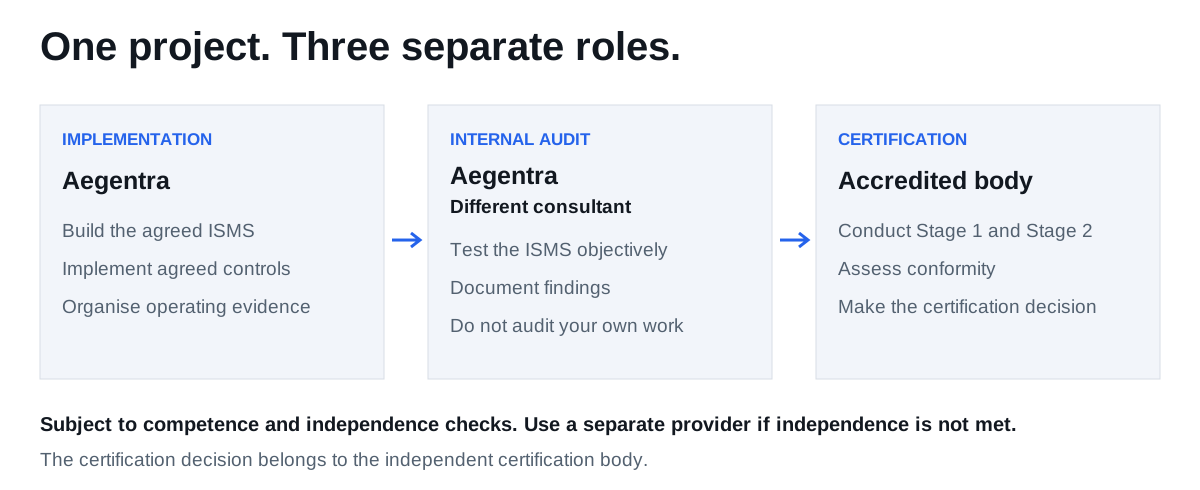
There are three different jobs behind an ISO 27001 certificate.
Implementation means establishing and operating your ISMS: defining its scope, assessing risks, selecting controls, assigning owners, making necessary changes and keeping evidence. This work can be completed in-house, with a consultant or through a hybrid arrangement.
Internal audit tests whether the ISMS meets the organisation’s audit criteria and is effectively implemented and maintained. Where Aegentra performs implementation, a different Aegentra consultant carries out the internal audit, subject to competence, conflict-of-interest and impartiality checks. The auditor must be independent of the implementation work and must not audit their own work. If independence cannot be maintained, a separate provider is required. Internal audit is not the certification audit.
Certification is the independent assessment and certification decision. An accredited certification body conducts Stage 1 and Stage 2. ISO publishes standards; it does not itself issue your organisation’s certificate. Source: ISO certification guidance
A proposal described as “ISO 27001 from A$10,000” may cover only consulting, only external auditing or a restricted scope. Ask who performs each job, what is included and who pays for the remaining work.

What does each part of ISO 27001 cost?
The following allowances are intended for budgeting a relatively straightforward Australian small-to-medium organisation. They are not mandatory purchases or amounts to add together automatically. For example, a consultant’s implementation fee may already include the gap assessment and training.
External-price allowances in the table below are in Australian dollars, excluding GST where applicable. Staff time is an internal economic cost, not a supplier invoice; do not add GST to employee wages in your model.
| Cost component | Illustrative allowance | What to check in the quote |
|---|---|---|
| Gap assessment and scope review | A$2,000–A$8,000 once | Is it a standalone report, or included in implementation? Does it assess operating evidence and technical gaps? |
| ISMS implementation or consulting | A$8,000–A$40,000+ once | Confirm deliverables, workshops, drafting, risk assessment, control implementation, evidence support and exclusions. |
| Independent internal audit | A$2,300–A$8,500+ per engagement | Scope, sampling, interviews, sites, reporting and corrective-action follow-up affect the fee. Aegentra’s starting price is scope-dependent. |
| Certification-body Stage 1 audit | A$2,500–A$6,000 | Confirm readiness/document review, sites, audit days and any repeat assessment charges. |
| Certification-body Stage 2 audit | A$5,500–A$14,000+ | Confirm assessment days, technical complexity, travel and follow-up verification charges. |
| Annual surveillance audit | A$3,000–A$10,000+ per audit | This is the external audit fee, not the complete annual cost of running the ISMS. |
| Recertification audit | A$6,000–A$15,000+ at renewal | Confirm timing before certificate expiry and whether renewal replaces that year’s surveillance visit. |
| Additional software and security licences | A$0–A$15,000+ a year | Zero means no incremental purchase, not that your existing technology or administration is free. |
| Training and awareness | A$500–A$3,000+ initially | Separate general staff awareness from specialist training for the ISMS owner. |
| Technical remediation and specialist testing | Separately scoped; A$0–A$25,000+ as an initial allowance | Identify configuration, endpoint, identity, backup, application-security and other risk-selected work. Major remediation can exceed this considerably. |
| Internal staff time | Hours × your fully loaded hourly cost | Include management decisions, process-owner input, evidence collection, interviews and ongoing control operation. |
Budgeting method: These bands are editorial allowances for the stated scenario, not surveyed market averages. Scope-specific professional fees can sit outside them. The worked example below provides a fully stated, additive model; the component ranges above do not imply a universal minimum or maximum total.
Why can certification-body audit quotes differ?
The certification body needs to understand the ISMS boundary, relevant personnel, activities, complexity and locations before establishing its audit programme. Employee numbers matter, but they are not a complete pricing formula. Ask how contractors, outsourced services, remote working and multiple sites have been treated. Compare the quoted audit days, day rates, travel, administration and follow-up charges against the same scope. Source: DNV certification cost guidance
Request a written three-year audit programme covering Stage 1, Stage 2, surveillance, renewal assumptions, travel and administration charges. Check the body’s accreditation for ISO/IEC 27001 and the acceptance requirements of your customer or tender. ISO/IEC 27006-1 sets requirements for bodies auditing and certifying information security management systems. ISO/IEC 27006-1 · JAS-ANZ
How does the budget change with business size?
Use these bands to start a budget conversation, not to select a package by headcount alone. The boundaries deliberately avoid counting a 20-person or 50-person business in two bands.
| People in the organisation | Initial core-project allowance | Example assumptions |
|---|---|---|
| 1–20 | A$15,000–A$35,000 | A narrow, legitimate business scope; one main environment; accessible evidence; an available internal owner. |
| 21–50 | A$25,000–A$60,000 | A growing SaaS or professional-services business with multiple process owners and some implementation work. |
| 51–200 | A$45,000–A$100,000 | More departments, suppliers, systems and assurance coordination; possibly several sites. |
| 201+ | A$100,000–A$250,000+ | Illustrative enterprise allowance only; complex or multinational programmes require a bespoke estimate. |
Core project means gap/scoping work, ISMS implementation, initial internal audit, initial certification audits and basic training. It excludes substantial technical remediation, separately purchased software, specialist testing and internal labour. These are scenario-based planning bands, not quotations or evidence that every business in a band pays the same amount.
A 15-person company handling sensitive customer data across a complicated application stack can need more work than a 60-person business with a mature, consistently operated environment.
What makes ISO 27001 more or less expensive?
How much difference does the certification scope make?
A clear scope defines the business activities, locations, systems and interfaces being certified. A focused scope can reduce unnecessary work, but it still needs to represent the service and information risks your customers are relying on.
Do not exclude a critical team, supplier or system simply to obtain a cheaper certificate. Agree the proposed scope with the certification body and check that it satisfies the buyer’s actual requirement.
Do existing controls reduce the implementation cost?
Working controls, named owners and retrievable evidence reduce the amount that needs to be built. Written policies alone are less useful when the organisation cannot demonstrate that people follow them.
ISO 27001 is risk-based. The Statement of Applicability records applicability and implementation status for the Annex A reference controls; it is not a reason to buy every security product or implement every control indiscriminately. The management-system requirements and your risk treatment decisions drive the work. Source: ISO/IEC 27001
Is cloud cheaper than on-premises?
It can be, particularly where a small company already has a consistently managed cloud environment. However, cloud services still require appropriate identity, access, configuration, supplier management and evidence.
Your cloud provider’s ISO 27001 certificate does not certify your own organisation or how you configure its services. On-premises environments may add physical-security, infrastructure, maintenance and recovery work, but the real cost depends on what is already operating effectively.
Does Essential Eight maturity help?
Existing Essential Eight controls may reduce relevant technical remediation. They do not replace the ISMS scope, risk process, management responsibilities, supplier governance, internal audit or other ISO 27001 work.
Use the ASD guidance and assessment version relevant to your engagement. ASD announced consultation on an evolution of the Essential Eight in June 2026, so a new project should confirm the current published requirements rather than rely on an old checklist. ASD maturity model · ASD consultation notice, 15 June 2026
Do ANAB, IAS or JASANZ change the certification cost?
ANAB and IAS are accreditation bodies, not different levels of ISO 27001 certification. A certification body audits your organisation and issues its certificate. An accreditation body assesses the certification body's competence and impartiality for a defined scope, such as ISO/IEC 27001. ISO itself does not issue certificates. ISO explains certification and accreditation
Do you need implementation only or accredited certification?
You can implement an ISMS without seeking certification, but implementation or an internal audit does not make your organisation certified. If a customer requires an accredited certificate, include the certification body's initial audits, surveillance and renewal in the budget. A non-accredited certificate is not the same assurance arrangement and may not meet that requirement. Establish the required outcome before comparing prices.
What do the accreditation names mean?
| Accreditation body | What the name means for your buying decision |
|---|---|
| ANAB — ANSI National Accreditation Board | A US-based accreditation body with an ISO/IEC 27001 certification-body accreditation programme. Confirm that the body quoting your audit holds the relevant current scope. ANAB programme |
| IAS — International Accreditation Service | Also US-based, IAS accredits management-system certification bodies, including for ISO/IEC 27001. IAS accreditation is not a lower grade of the standard or an Asia-only certificate. IAS programme |
| JASANZ — Joint Accreditation System of Australia and New Zealand | Australia and New Zealand's joint accreditation body. Check the proposed certification body's scope and whether your buyer specifically requires JASANZ or accepts other recognised accreditation. About JASANZ |
Indicative partner certification-body quotes in USD
Aegentra has received indicative quotes from certification-body partners for the audit fees below. Initial certification includes Stage 1 and Stage 2. Surveillance is shown per annual audit. These amounts are in US dollars (USD), not Australian dollars, and cover certification-body audits—not ISMS implementation or the separately scoped internal audit.
| Certification body's accreditation | Initial certification audit: Stage 1 + Stage 2 (USD) | Surveillance: per annual audit (USD) |
|---|---|---|
| IAS-accredited certification body | US$5,000–6,000 | US$2,600 |
| ANAB-accredited certification body | US$6,000–9,000 | US$4,000 |
Pricing information confirmed by Aegentra on 18 September 2026. These are scope-dependent partner quote examples, not market averages, fixed accreditation-body fees or a guaranteed price for your organisation. Obtain a written quotation for your scope, people, sites and audit requirements. Confirm whether taxes, travel, administration and corrective-action follow-up are included, and ask for the recertification fee, before comparing totals. The difference between these examples does not establish that one accreditation is a higher grade or is always more expensive.
Which accreditation do customers in different countries need?
Follow the customer's written requirement, not a country-to-logo rule. For an Australian or New Zealand tender, check whether a particular accreditation is named or equivalent recognition is accepted. For a US customer, do not assume ANAB is mandatory or IAS is unacceptable simply because the customer is American. For customers in several countries, ask their procurement teams to confirm acceptance of the proposed certification body, accreditation and certificate scope before booking.
International recognition arrangements support cross-border confidence; they do not override a specific contract. Since January 2026, Global Accreditation Cooperation Incorporated (Global ACI) has brought together the former IAF and ILAC arrangements, with continuity of existing recognition during transition. Its August 2026 signatory list records ISO/IEC 27001 recognition for ANAB, IAS and JASANZ. Check the relevant recognition scope as well as the certification body's accreditation. IAS transition guidance · Global ACI signatory scopes
Why might the accepted options have different prices?
Your buyer's requirements can narrow the certification bodies you can choose. Their audit programmes, rates, auditor availability, travel and contract terms may then produce different quotes. Do not assume a fixed ANAB surcharge or that IAS is always cheaper: an accreditation logo alone is not a price list. Compare the complete certification cycle for the same scope, including relevant sector experience, auditor availability and service terms. Confirm what any price difference actually covers.
Before committing, verify the certification body's current ISO/IEC 27001 accreditation in the relevant register. Once issued, check the certificate's organisation name, scope, sites and validity through the issuer and an appropriate verification service such as IAF CertSearch. If a record is unclear, confirm it directly with the certification or accreditation body. Sources checked: 18 September 2026.
Is it cheaper to implement ISO 27001 yourself?
DIY can reduce external consulting fees, but it transfers work and responsibility to your own people. It does not remove the need for an effective ISMS, impartial internal audit or an independent certification assessment.
| Approach | Where the work sits | Cost advantage | Main trade-off |
|---|---|---|---|
| DIY | Your internal ISMS owner and technical team build and operate the system. | Lower external consulting spend when the necessary competence and time already exist. | Internal time, interpretation mistakes and delayed remediation can outweigh the saving. |
| Consultant-led | A consultant leads the agreed governance and implementation work. | Access to delivery capacity and experience without recruiting a full team. | A low-priced documentation-only scope may still leave most technical changes with you. |
| Hybrid | Your team owns decisions and routine operation; specialists deliver defined gaps. | You buy support where it is genuinely needed. | Responsibilities, dependencies and acceptance criteria must be explicit. |
For a small business, a practical hybrid can be an internal owner, an implementation specialist, a separate internal auditor and an independent certification body. Compare the total workload and outcome, not just the consultant’s daily rate.
How much does Aegentra charge for implementation and internal audit?
What is Aegentra’s ISO 27001 implementation price?
Aegentra quotes a fixed implementation fee after discovery. There is no universal advertised implementation starting price in this guide because the work depends on your scope, existing controls, technical environment and the responsibilities you want Aegentra to take on.
Your proposal should identify the ISMS deliverables, agreed technical changes, evidence support, responsibilities, assumptions, exclusions, delivery plan and fee. Internal audit and certification-body charges remain separate. The illustrative prices elsewhere in this guide are not Aegentra implementation offers.
How much does an Aegentra internal audit cost?
Aegentra’s standalone ISO 27001 internal audits start from A$2,300 plus GST — A$2,530 including GST — for a smaller, single-scope organisation with a clear ISMS boundary and straightforward evidence access.
The final fixed fee depends on locations, processes, applicable controls, previous findings, evidence volume, interviews, sampling and any onsite work. The written scope confirms what is included before the engagement begins.
Where Aegentra implements your ISMS, a different Aegentra consultant performs the Clause 9.2 internal audit, subject to competence, conflict-of-interest and impartiality checks. The auditor must be independent of the implementation work and must not audit work they designed, implemented or operate. Findings are reported directly to your management without interference from the implementation consultant. If independence cannot be maintained, a separate provider is required. Aegentra also offers standalone internal audits for systems implemented in-house or by another provider, subject to the same checks. Internal audit is separately scoped and priced from implementation.
Explore ISO 27001 implementation · View the standalone internal-audit service
Can Aegentra do the technical work when we have no IT or GRC team?
Yes. Aegentra can combine governance work with agreed hands-on technical implementation, rather than deliver a report and leave a startup or small team to interpret it alone.
For a Microsoft 365-first organisation, the scope can include identity and access configuration, multi-factor authentication, privileged-access separation, device-management settings, email-security configuration, collaboration and sharing controls, and supported information-protection or audit settings. The actual changes depend on your risks, licences, architecture, approvals and agreed scope; not every feature is required or available in every tenant.
Aegentra can also help organise evidence linking technical settings to the relevant risks, controls and owners. Supported Aeges evidence collection does not replace management decisions, people and supplier records, physical-security evidence, interviews or professional judgement.
You still need a business sponsor who can approve decisions, provide access and accept ongoing responsibilities. One-off implementation does not automatically include a permanent IT help desk, continuous monitoring or an ongoing outsourced GRC function. Those services need their own scope and price.
What would a 25-person Melbourne SaaS company spend?
Consider a fictional 25-person SaaS business in Melbourne with one principal cloud environment, Microsoft 365, no dedicated GRC team and a nominated internal owner. It wants an ISMS scope covering its SaaS service and the supporting business processes.
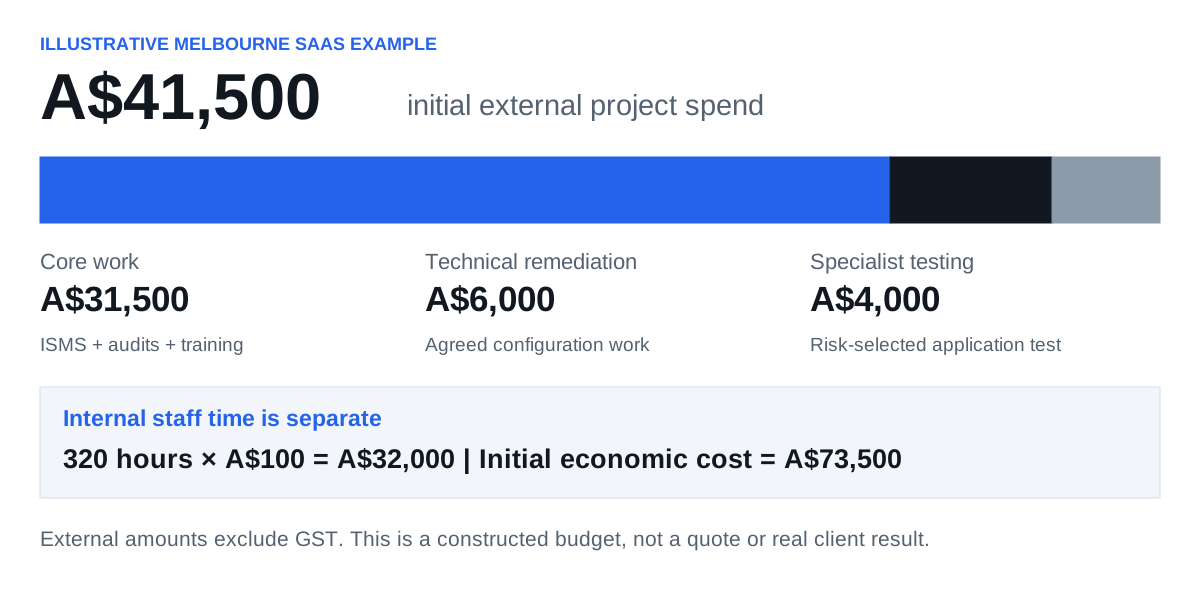
This is a worked budget, not a client case study, historical invoice, certification-body quote or Aegentra offer. It assumes the business needs some technical remediation and a risk-selected application penetration test. An internal auditor independent of the implementation work is appointed under a separate audit scope.
| Initial item | Model allowance, excluding GST |
|---|---|
| Gap assessment and scope | A$3,000 |
| ISMS implementation support | A$14,000 |
| Agreed technical remediation | A$6,000 |
| Independent internal audit | A$3,500 |
| Certification-body Stage 1 | A$2,500 |
| Certification-body Stage 2 | A$7,500 |
| Initial training and awareness | A$1,000 |
| Risk-selected application penetration test | A$4,000 |
| Initial external project spend | A$41,500 |
Of that amount, A$31,500 is the core implementation and certification budget and A$10,000 is technical remediation and specialist testing. This distinction matters when comparing the example with a quote that covers governance only.
The model separately allows 320 internal hours at A$100 per hour: A$32,000 in staff opportunity cost. Its initial economic cost is therefore A$73,500, before ongoing operation. Replace both the hours and hourly rate with your own assumptions.

What is the total three-year cost of ownership?
A certificate is not the end of the budget. You must continue operating the ISMS, maintaining evidence and addressing changes and findings.
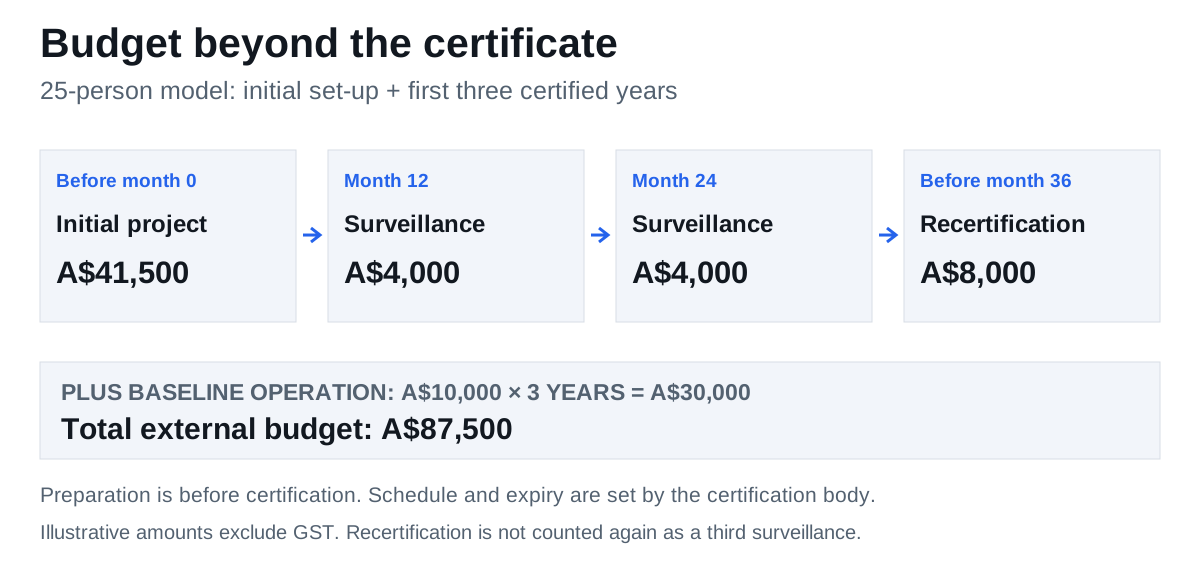
The table below models initial set-up plus the first three certified years, including recertification at the end of the certificate cycle. It therefore includes the preparation period before the certificate is issued. It is not a claim that every payment falls within 36 months of project kickoff.
| Illustrative organisation | Initial set-up | Three years of baseline operation | Two surveillance audits | Recertification | Total external spend |
|---|---|---|---|---|---|
| 10-person business | A$22,000 | A$15,000 | A$6,000 | A$6,000 | A$49,000 |
| 25-person SaaS example | A$41,500 | A$30,000 | A$8,000 | A$8,000 | A$87,500 |
| 100-person organisation | A$80,000 | A$75,000 | A$16,000 | A$14,000 | A$185,000 |
| 300-person organisation | A$160,000 | A$180,000 | A$36,000 | A$30,000 | A$406,000 |
These are four constructed scenarios, not observed market averages or quotes linked to headcount. All external amounts exclude GST where applicable. Baseline operation includes the specific software, support, training and internal-audit provision assumed for each scenario. External surveillance and renewal are shown separately to avoid double counting.
For the 25-person example, annual baseline operation is A$10,000: A$3,600 for incremental licences, A$3,500 for its chosen annual internal-audit engagement, A$500 for refresher training and A$2,400 for defined technical maintenance. External surveillance is A$4,000 at each of the first two anniversaries; recertification is A$8,000 before expiry.
| Period in the 25-person example | External spend |
|---|---|
| Initial project, before certification | A$41,500 |
| First certified year: operation plus surveillance | A$14,000 |
| Second certified year: operation plus surveillance | A$14,000 |
| Third certified year: operation plus recertification | A$18,000 |
| Total | A$87,500 |
Add the model’s A$32,000 of initial staff time and 120 hours a year × A$100 × three years = A$36,000 of ongoing staff time. That produces A$155,500 of total economic cost: A$87,500 external expenditure plus A$68,000 internal labour.
Your certification body’s actual programme takes priority. Surveillance is normally scheduled through the certification cycle, with the first surveillance no later than 12 months after the certification decision; renewal needs to be completed in time to avoid expiry. A recertification visit should not be counted again as a separate routine surveillance visit in the same model unless the quoted programme genuinely requires both. Source: Bureau Veritas certification process
How long does implementation and certification take?
For a straightforward business, three to six months is a useful planning scenario, not a promised result. A complex organisation, weak starting controls, limited staff availability or substantial remediation can extend the programme to six to twelve months or longer.
Aegentra may target an approximately 12-week implementation programme for an appropriately scoped Microsoft 365-first organisation with sufficient leadership availability and no major remediation blockers. That is an implementation planning assumption, not a guaranteed certificate date.
| Phase | What needs to happen before moving on |
|---|---|
| Define the scope and budget | Confirm the ISMS boundary, owners, obligations, starting position and responsibilities. |
| Implement and operate | Establish the management system, complete agreed changes and retain real operating evidence. |
| Test readiness | Complete the planned internal audit, management review and necessary corrective actions. |
| Complete Stage 1 | The certification body assesses readiness and identifies issues to address before Stage 2. |
| Complete Stage 2 | The body evaluates implementation and effectiveness; findings must be handled appropriately. |
| Reach the certification decision | The certification body completes its decision process; consultancy completion is not certification. |
| Maintain and renew | Operate the ISMS, complete the audit programme and prepare recertification before expiry. |
Some activities overlap, but artificial deadlines cannot substitute for operating evidence. Book the certification body early enough to understand availability without assuming the organisation will be ready on a particular day.

What happens if you fail the Stage 1 audit?
Stage 1 is primarily a readiness assessment. Significant gaps can mean you are not ready to proceed to Stage 2, rather than that your organisation is permanently barred from certification.
Ask the certification body to clarify the concerns, evidence required, deadlines and whether another review or visit will be charged. You may need to complete risk assessment work, clarify the scope, improve documented information, finish internal audit and management review, or demonstrate that controls are operating.
The hidden cost is often staff time and delay as much as the auditor’s additional fee. Avoid assuming that a consultant’s “audit support” automatically includes unlimited remedial work or repeat certification-body visits.
What happens if you fail the Stage 2 audit?
Stage 2 findings need to be understood by severity and addressed through the certification body’s process. A major nonconformity prevents certification until the required correction and corrective action have been accepted and their effectiveness verified. A minor finding still needs an acceptable response; it does not automatically mean starting the entire project again.
A useful response identifies the issue, corrects the immediate problem, investigates the cause and implements action to prevent recurrence. Agree evidence and verification arrangements with the certification body instead of inventing your own deadline.
There is a material timing risk: where corrections and corrective actions for a major nonconformity cannot be verified within six months after the last day of Stage 2, another Stage 2 audit is required before certification can be recommended. This is why unresolved major findings can create additional audit cost. Source: European co-operation for Accreditation guidance on ISO/IEC 17021 requirements
Ask about follow-up review charges, additional site visits, rebooking, evidence review and any contractual implications for your customer deadline. No consultant should promise that paying for extra support guarantees the certification decision.
How can you reduce the cost without weakening security?
- Agree one legitimate scope before requesting quotes. Give each provider the same sites, systems, headcount, activities and expected outcome.
- Reuse controls that genuinely work. Assess existing licences and configurations before buying another platform; verify implementation and evidence rather than relying on a product name.
- Name one accountable internal owner. Timely decisions and organised evidence prevent avoidable workshops, repeat questions and delayed audits.
- Buy implementation where you need implementation. A lower consulting fee is not a saving when an unsupported internal team must complete all technical remediation.
- Complete an objective internal audit before external assessment. Use findings to fix root causes and improve readiness, while protecting auditor independence.
- Compare the complete certification cycle. Ask about surveillance, renewal, support, software exit terms and follow-up fees, not only the first invoice.
Training an internal owner can support a hybrid approach, but it does not remove the need for practical competence, delivery time or independent assessment.
How do ISO 27001, SOC 2 and Essential Eight costs compare?
They address different assurance needs. ISO 27001 provides certification of an ISMS. SOC 2 is a CPA attestation report, not an ISO-style certificate. Essential Eight is an Australian technical mitigation framework, not an equivalent organisational certification scheme. Choose the outcome your customer, risk profile or procurement requirement actually calls for. ISO · AICPA & CIMA · ASD
The examples below illustrate budgeting mechanics for a small cloud business. They are not market-price comparisons, equivalent assurance scopes or quotations.
| Outcome | Illustrative initial external budget | What the number assumes | Recurring consideration |
|---|---|---|---|
| ISO 27001 | A$41,500 | The 25-person example above, including A$10,000 of technical remediation and testing. | ISMS operation, surveillance and renewal; A$87,500 external set-up-plus-cycle model above. |
| SOC 2 Type II | A$44,000 | Assumed A$15,000 readiness support + A$25,000 CPA examination + A$4,000 incremental tools. Separate remediation and internal labour are not included. | Continuing control operation and subsequent reports requested by customers; obtain the CPA firm’s scoped quote and reporting-period requirements. |
| Essential Eight assessment and uplift | A$24,000 | Assumed four assessment days × A$1,500, ten remediation days × A$1,500 and A$3,000 in incremental licences. | Ongoing control operation, licence renewal and reassessment according to risk and contractual requirements. |
SOC 2 Type II includes testing of operating effectiveness over a defined period; completing readiness work does not create that history retrospectively. Essential Eight maturity is assessed against its specified requirements and target level, not simply the amount spent.
Do not interpret the lowest model total as the best purchase. Shared controls can reduce duplicated work when pursuing more than one framework, but they do not make the assessments interchangeable or guarantee a particular saving.
Why do Australian businesses pursue ISO 27001?
Does ISO 27001 help with government tenders and enterprise customers?
A customer may request accredited certification, alignment with a standard or other security evidence. Read the actual tender or contract: these are different requirements, and ISO 27001 is not universally compulsory for every Australian government supplier.
For example, Victorian Government procurement guidance uses a risk-based approach to information-security requirements. Certification can support a buyer’s assessment, but its scope still needs to cover the service being purchased. Source: Buying for Victoria information-security guidance
Does certification make you compliant with the Privacy Act?
No. Where the Australian Privacy Principles apply, APP 11 requires reasonable steps to protect personal information, including relevant technical and organisational measures. The required measures depend on the circumstances.
ISO 27001 can help structure security governance, but certification does not automatically establish Privacy Act compliance or prove that every necessary reasonable step has been taken. Check the obligations that actually apply to your business. OAIC APP 11 guidance · OAIC security guide
Will certification reduce cyber-insurance premiums?
Do not include an assumed premium discount in your business case. Ask your broker or insurer whether the proposed controls, assurance evidence and certification scope affect your specific underwriting terms.
Certification is not a promise that an incident cannot happen or that an insurer will cover every loss. Use the insurer’s written terms and quotation, not a generic percentage saving from a marketing article.
What should you do after getting certified?
Keep the ISMS operating. Continue the access reviews, incident processes, supplier reviews, training, monitoring and other activities your risk treatment and policies require. Retain evidence as work happens rather than reconstructing a year of activity before an audit.
Maintain the management cycle. Review changes, risks, objectives, findings and performance. Conduct internal audits at planned intervals and management reviews as required by your management system. ISO 27001 does not prescribe one universal complete internal audit every calendar year; the programme must be appropriately planned and justified.
Protect the certificate’s validity and scope. Follow the certification body’s conditions, notify relevant changes, complete surveillance and address findings. Use certification marks only as authorised and describe the certified scope accurately; do not present a certificate for one service as covering the entire group.
Prepare renewal before expiry. Confirm the recertification schedule and keep time available for findings and the certification decision. Allowing a certificate to lapse can disrupt customer assurance even when much of your underlying security remains in place.
What else do businesses ask about ISO 27001 costs?
How much does ISO 27001 cost for a small business?
For a relatively straightforward 1–20-person business, this guide uses an illustrative A$15,000–A$35,000 initial core-project allowance, excluding GST. Add substantial technical remediation, separately purchased software, specialist testing and internal staff time; this is a planning band, not an Aegentra quotation.
What is the cheapest way to get ISO 27001 certified?
The lowest responsible cost usually comes from a legitimate, focused scope, working existing controls and an internal owner with time to deliver. DIY can reduce consulting spend, but it does not remove independent certification, impartial internal audit or the need to demonstrate an effective ISMS.
Do you have to pay for ISO 27001 every year?
Certification creates ongoing costs for operating the ISMS and meeting the certification body’s audit programme. Budget for surveillance and maintenance during the cycle, then recertification before expiry, rather than treating the first certificate as a one-off purchase.
How much does an ISO 27001 surveillance audit cost?
This guide uses an illustrative A$3,000–A$10,000-plus allowance per surveillance audit for relatively straightforward small-to-medium scopes, excluding GST. Obtain a certification-body quote because sites, complexity, audit duration, travel and changes to the scope can alter the fee.
Can we get ISO 27001 certified without a consultant?
Yes, an organisation can implement its ISMS using its own competent people. It still needs to protect internal-audit objectivity and obtain independent assessment from a certification body; internal preparation time should remain in the budget.
Is ISO 27001 certification mandatory in Australia?
It is not a universal legal requirement for every Australian business. A specific tender, contract, customer or regulatory context may create security or assurance requirements, so check the actual wording instead of assuming all businesses need the same certificate.
How long does ISO 27001 certification take?
A straightforward organisation can use three to six months as a planning scenario, while significant remediation or complex scope can extend the programme. Implementation progress, operating evidence, findings and the certification body’s schedule determine the actual timing.
What happens if we fail Stage 1?
The certification body may decide that the organisation is not ready for Stage 2 and require gaps to be addressed first. Confirm the required evidence, timetable and any repeat-review fees; Stage 1 concerns do not automatically require rebuilding the whole ISMS.
What happens if we fail Stage 2?
Major nonconformities need appropriate correction, corrective action and verification before certification can proceed. Minor findings also require an acceptable response, and the certification body determines the necessary follow-up and deadlines.
Is SOC 2 cheaper than ISO 27001?
Not necessarily: the scope, readiness work, report type, examination period and customer expectations affect the comparison. SOC 2 produces a CPA attestation report rather than an ISO-style certificate, so compare like-for-like assumptions and the outcome your buyer requires.
Does Essential Eight replace ISO 27001?
No, the frameworks address different scopes and outcomes. Essential Eight controls can support relevant technical risk treatment, but they do not replace the complete ISO 27001 management system and certification process.
Do we need compliance software or a Lead Implementer course?
ISO 27001 does not require a particular commercial compliance platform or a named personal training certificate. Appropriate tools and training can help your team work effectively, but an individual PECB credential is separate from your organisation’s ISO 27001 certification.
Would a scoped discussion help you build a realistic budget?
Start with the service you need certified, your current environment and the work your team can realistically own. A useful proposal should show what is included, what remains with you and which third-party fees sit outside the implementation price.
Book a free initial consultation with Aegentra to discuss your scope and delivery options. Implementation is quoted after discovery; standalone internal audits start from A$2,300 plus GST, subject to scope and independence. Aegentra is based in Melbourne and delivers remotely across Australia, including Sydney, Brisbane and Perth, with onsite work and travel by arrangement.
Discuss your ISO 27001 budget · Explore Aegentra Govern
For an internal owner building implementation knowledge, explore the Aegentra Academy PECB ISO/IEC 27001 Lead Implementer course. Check the course page for current study modes, pricing and inclusions. Personal training supports competence; it does not certify your company or replace the implementation work.
View the PECB Lead Implementer course
Who wrote this guide?
Harry Sidhu · Founder of Aegentra · PECB-certified ISO/IEC 27001 Lead Implementer
Harry focuses on practical ISMS implementation, Microsoft 365 security and clear separation between implementation, internal audit and independent certification. This guide provides budgeting information, not a certification guarantee, legal opinion or personalised supplier quotation.
How were the costs and sources used?
The price bands and worked examples are transparent planning assumptions prepared for this guide. They are not an Australian market survey, audited cost dataset or evidence that every organisation will fit a published range. Replace assumptions with written scope-specific quotes and your own internal labour costs.
Official sources linked throughout this guide explain the standard, certification process and related obligations; they do not endorse or publish the commercial prices in this guide. Aegentra’s own service prices and boundaries should be checked against its current service pages before purchase.